Introduction
Most guides to "AI ad generation" stop at the fun part — typing a prompt and watching an ad appear. What they skip is everything after that: getting it approved, formatting it for five different platforms, and actually publishing it on a schedule without someone manually uploading files at 9am every day. That whole pipeline is where AI tools either save you real time or just become one more app you forgot to use.
This guide walks through the full loop, from first idea to the ad actually going live.
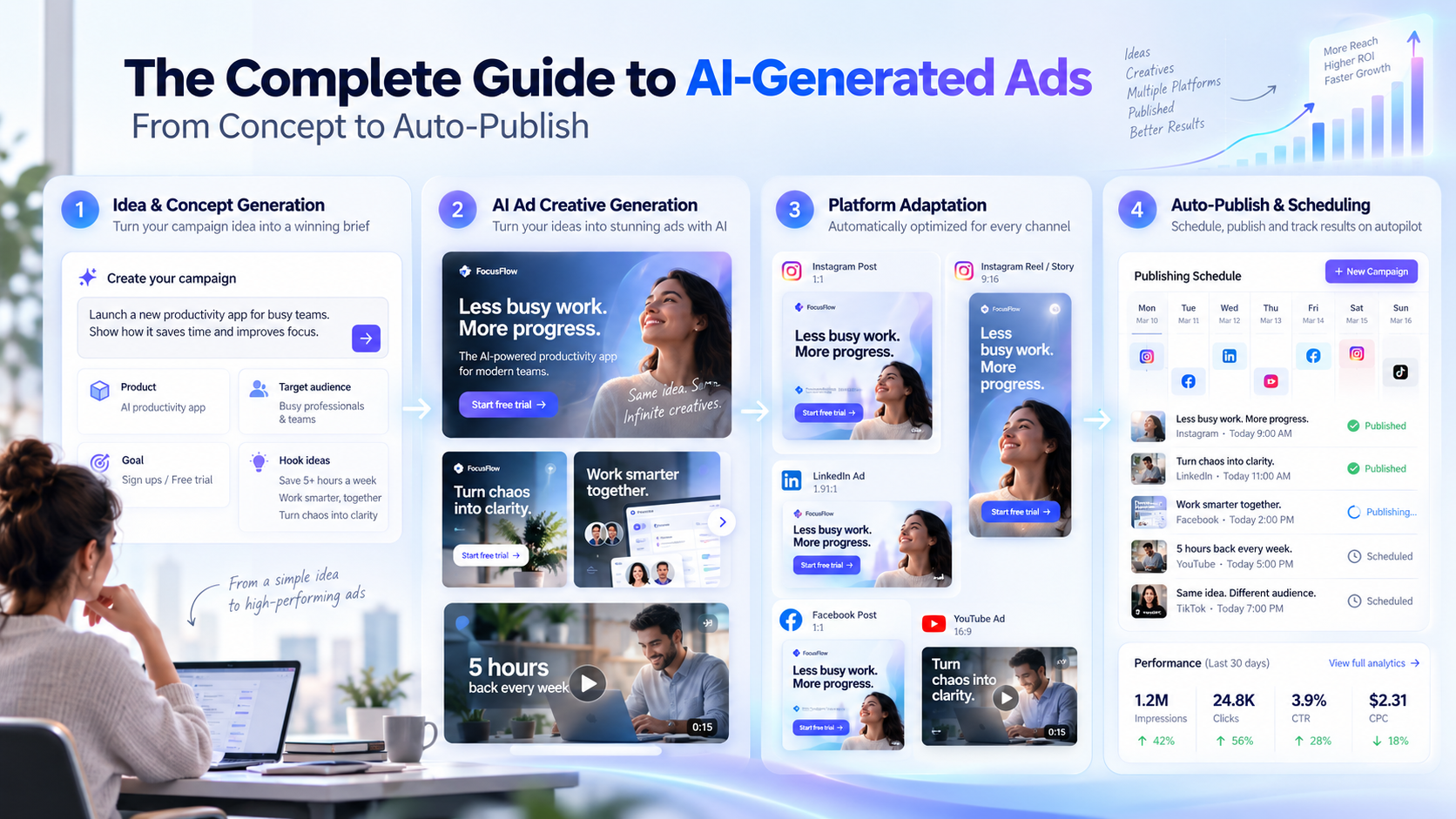
Step 1: Getting from idea to ad concept
The hardest part of ad creation has never really been the design — it's the blank page. What's the hook? What's the visual? What's the CTA? An AI ad generator shortcuts this by taking basic inputs — your product, your audience, your goal — and producing several concept directions at once, instead of you staring at a canvas waiting for inspiration.
This matters more than it sounds like. When you can see five different angles on the same product in ten minutes, you start noticing which one actually feels right, which is a very different (and faster) process than trying to invent one perfect idea from scratch.
Step 2: Generating the actual ad creative
Once you've picked a direction, the tool builds out the real asset — static image, carousel, or video ad — matched to your brand's colors, fonts, and tone. The advantage over a template library isn't just speed, it's relevance: the ad is built around your specific product and message, not retrofitted from something generic.
If video is the format you need, this is where an AI video generator comes in for ad-specific content — short, punchy, platform-native videos designed to stop a scroll rather than sit in a portfolio.
Step 3: Adapting for the platform it's actually going on
An ad that works on LinkedIn rarely works unchanged on Instagram. Aspect ratios, tone, even the amount of text people tolerate — all different. A lot of teams either skip this step (and get penalized with lower engagement) or burn hours manually resizing and rewriting for each platform.
Good AI ad tools handle this natively, generating platform-specific versions from a single concept instead of forcing you to start over for each channel.
Step 4: The part everyone forgets — publishing
This is genuinely where most "AI-generated content" workflows fall apart. You've got a great ad. Now what — download it, open five different apps, upload manually, set the boost budget by hand, and hope you remember to do it again next week?
Auto-posting is the piece that turns a one-off content trick into an actual system. Instead of ads sitting in a folder waiting for someone to publish them, they go out on a schedule automatically. For teams running always-on campaigns — new product drops, weekly promotions, seasonal pushes — this is the difference between content that's "created" and content that's actually working for you.
Putting the whole loop together
Here's what the process looks like end to end, once it's actually set up: you describe the campaign goal once, review a handful of AI-generated concepts, pick and lightly refine the strongest one, get platform-specific versions generated automatically, and let auto-publish handle the delivery on your schedule.
The part worth being honest about: this doesn't remove strategy from the equation. You still need to know your audience, your offer, and what a good ad actually looks like for your brand. What AI removes is the grunt work between having a good idea and that idea actually being live on the right platform at the right time.
Conclusion
Ad fatigue is real, and platforms increasingly reward accounts that test and iterate quickly rather than running the same three ads for six months. The teams pulling ahead right now aren't necessarily the ones with the biggest budgets — they're the ones who can go from concept to published ad the fastest, learn from what performs, and adjust without a two-week production cycle standing in the way.
That speed is the actual value of an end-to-end AI ad workflow. Not novelty. Throughput.