Introduction
If you're running B2B marketing on LinkedIn, you've probably had this exact debate internally: do we put budget behind a paid ad, or do we invest the time into an organic carousel post and hope it lands? The honest answer is that they're not really competing for the same job — but a lot of teams treat them like they are, and end up disappointed with whichever one they picked.
What LinkedIn carousels are actually good at
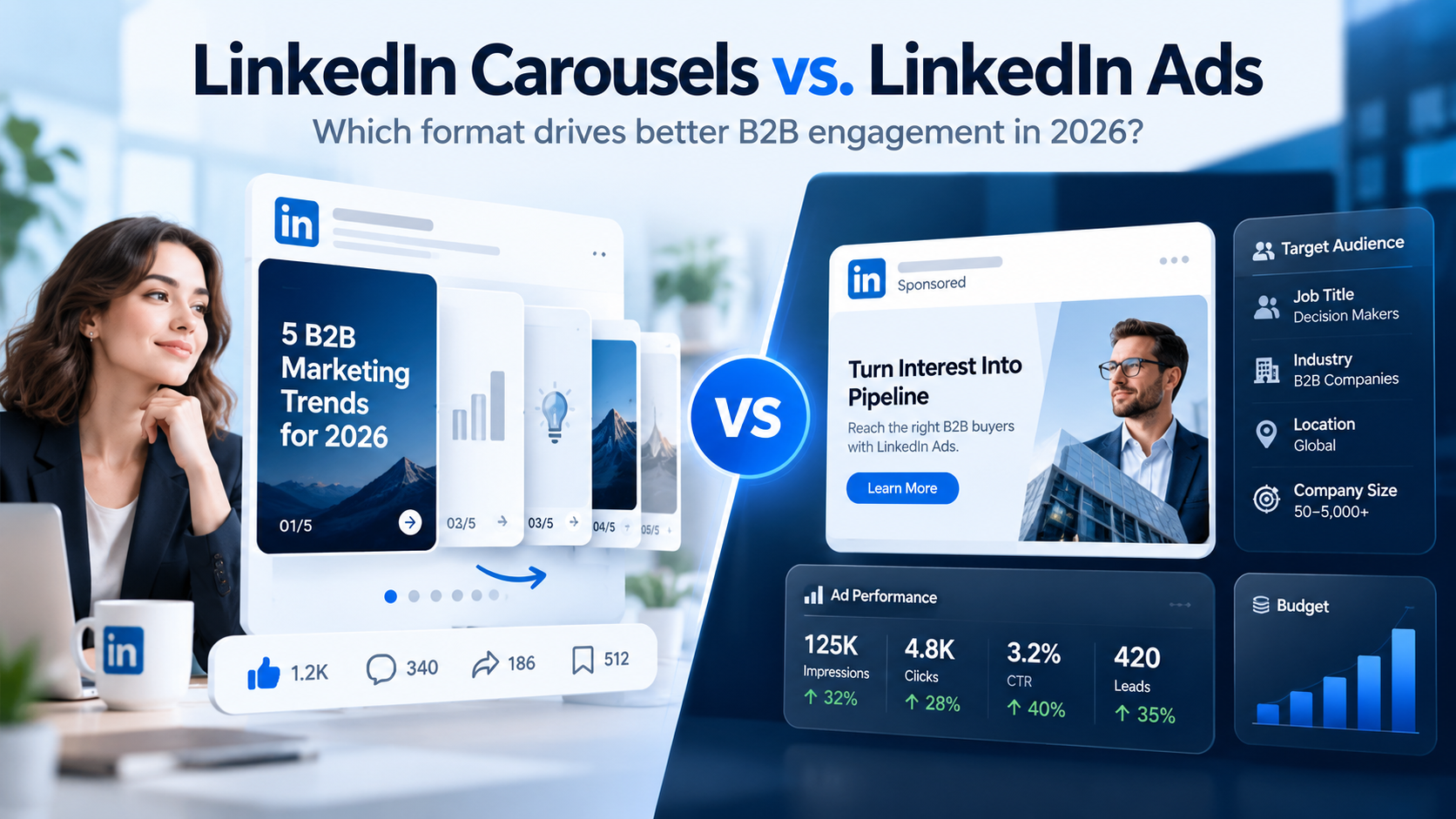
Carousels work on LinkedIn because the format matches how professionals actually consume content there — during a coffee break, between meetings, in short bursts of attention. A well-built carousel (say, "5 lessons from scaling our SaaS to $1M ARR") gets swiped through slowly, which LinkedIn's algorithm reads as a strong engagement signal and rewards with more reach.
The catch is that carousels are organic-first. They rely on your existing network and how shareable the content is — there's no guaranteed audience the way there is with paid reach. A LinkedIn carousel maker removes the production bottleneck (design, formatting, staying on-brand across 8–10 slides), but it can't manufacture reach out of nothing. You still need content genuinely worth swiping through.
What LinkedIn ads are actually good at
Ads solve a different problem entirely: predictable, targetable reach. If you need to get in front of a specific job title, industry, or company size — people who've never heard of you and wouldn't organically see your content — that's a job for paid, not organic.
The trade-off is cost and fatigue. LinkedIn ad costs per click are notoriously higher than most other platforms, and B2B audiences tend to be small and easy to burn out on repetitive creative. An AI LinkedIn ad maker helps here by making it cheap to produce multiple ad variations, so you're not spending your entire budget testing five headline options manually — you can generate and rotate creative fast enough to keep the same audience from going numb to it.
So which one actually drives more engagement?
It depends on what "engagement" means for your goal.
For brand authority and thought leadership, carousels usually win. Comments, shares, and saves — the engagement types LinkedIn weights most — come far more naturally from organic swipe content than from an ad someone was served mid-scroll. People engage with carousels because they chose to, not because they were targeted.
For pipeline and lead generation, ads generally win, simply because they can reach the specific decision-makers who'll never stumble onto your organic posts, no matter how good those posts are.
The combination that actually works
Most B2B teams doing this well in 2026 aren't picking one — they're sequencing them. A strong carousel that performs organically becomes the creative for a paid ad campaign, targeted at a cold audience that would never have seen it otherwise. You've already validated the message works before spending a rupee on media, which is a much better position than guessing at ad creative from scratch.
The practical version: post carousels regularly, watch which ones genuinely get engagement (not just impressions — actual comments and shares), and turn your top performers into paid ad creative aimed at the audience you actually want to reach.
Conclusion
Carousels build trust with people who already have some reason to find you. Ads put you in front of people who don't — yet. Treating them as competitors means you're probably underinvesting in one to overinvest in the other. Treating them as a pipeline, where organic proves the message and paid scales it, is where the real engagement gains are in 2026.