Introduction
There's an assumption that's been baked into marketing for decades: good ads cost money. Big production budgets, agency retainers, a team of people who know how to make a 15-second video look expensive. If you're running a small business or a lean team, that assumption has probably talked you out of running ads at all — or pushed you toward ones that look like they were made in five minutes, because they were.
That gap is closing faster than most small business owners realize, and it's worth understanding why.
The real reason small business ads look cheap
It's rarely a taste problem. Most small business owners have a decent eye for what looks good — they see enough ads in their own feed to know the difference. The actual bottleneck is production: no in-house designer, no budget for freelance video editors, no time to learn Photoshop between running the actual business.
So the ad either doesn't get made, or it gets made badly in Canva at 11pm the night before a sale starts. Neither outcome is really about the business lacking good instincts — it's about the gap between having an idea and having the resources to execute it well.
What's actually changed
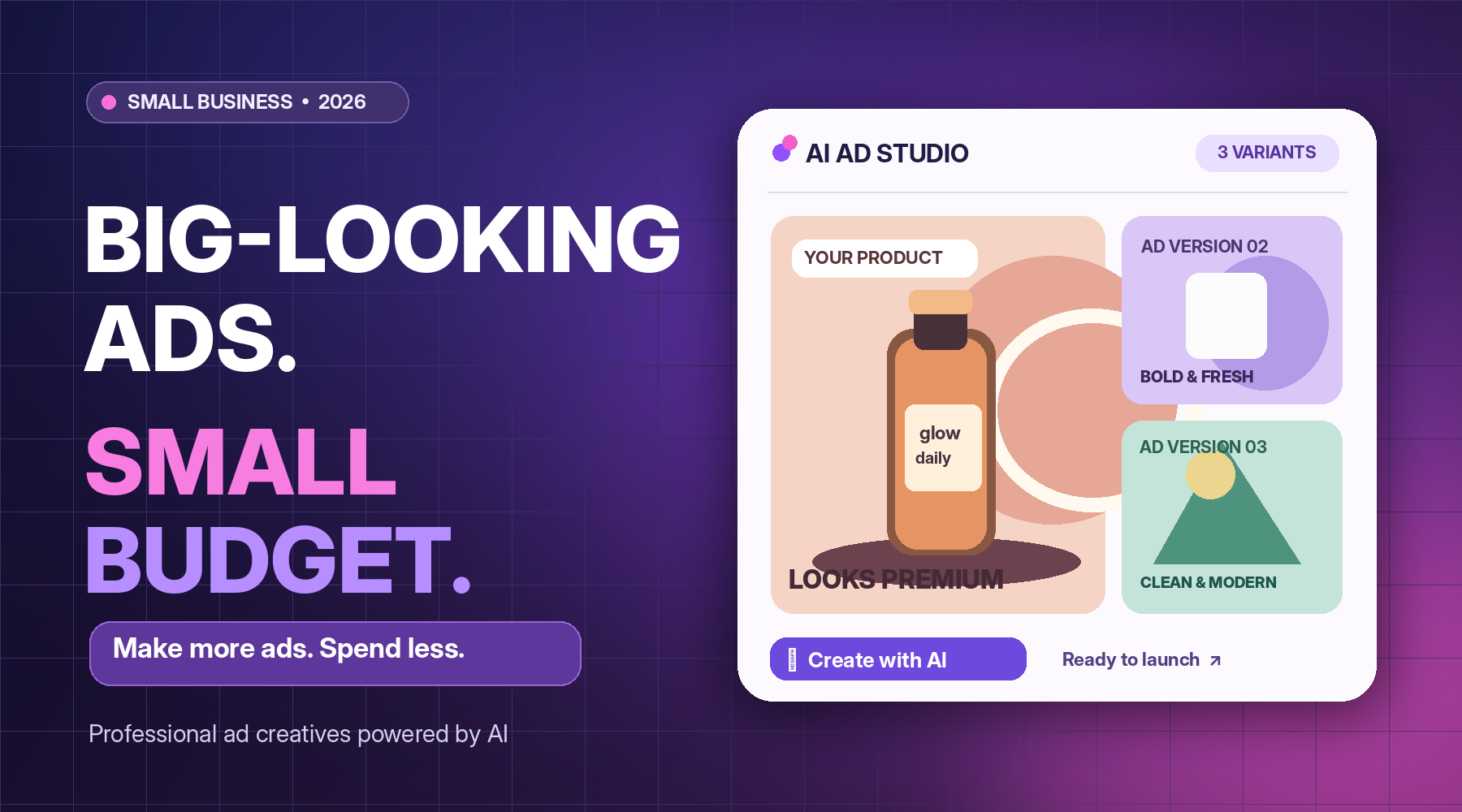
AI ad tools close that specific gap — not by replacing judgment, but by replacing the production team you never had. An AI ad generator takes your product, your brand colors, and a basic goal (more sales, more sign-ups, more awareness) and produces ad creative that looks like it came from a team, not a solo founder at midnight.
This matters most for the businesses that were priced out of good ads entirely. A local bakery, a boutique clothing brand, a one-person consulting practice — these aren't businesses that were ever going to hire an agency, but they can absolutely use a tool that generates on-brand ad creative in minutes.
It's not just about the image
A lot of small business ad content is static — a product photo with some text slapped on. That's fine, but it's also exactly what everyone else is doing, which means it blends in. Video ads consistently outperform static ones on engagement, largely because they're rarer in a small business's feed and they hold attention longer.
An AI video generator makes that format accessible without needing someone who knows how to edit. You're not learning a new skill or hiring someone who has one — you're describing what you want and getting a usable video ad back.
Competing on consistency, not just quality
Here's the part that actually matters more than people expect: one good ad doesn't move the needle much. What works is testing several versions of an ad to see which hook, which image, which offer actually lands with your audience — and most small businesses never get to do this because producing even one ad took all their time and energy.
When ad creation stops being the bottleneck, testing becomes realistic. You can run three versions of the same offer with different headlines, see which one performs, and lean into it — the same approach bigger brands use, just without needing their budget to do it.
What this looks like in practice
A small business owner with no design background can now describe their product, pick a goal, and walk away with ad creative that's ready to run — not a rough draft that needs a designer to finish. That's the actual shift: the ceiling on "how professional can my ads look" isn't tied to budget the way it used to be.
Conclusion
The businesses that benefit most from this shift aren't the ones already running big campaigns — they're the ones who've been sitting on the sidelines because "proper" advertising always felt out of reach. That barrier is a lot lower than it used to be. The budget that used to buy you one decent ad can now buy you the tools to test ten, and figure out what actually works for your business instead of guessing once and hoping.